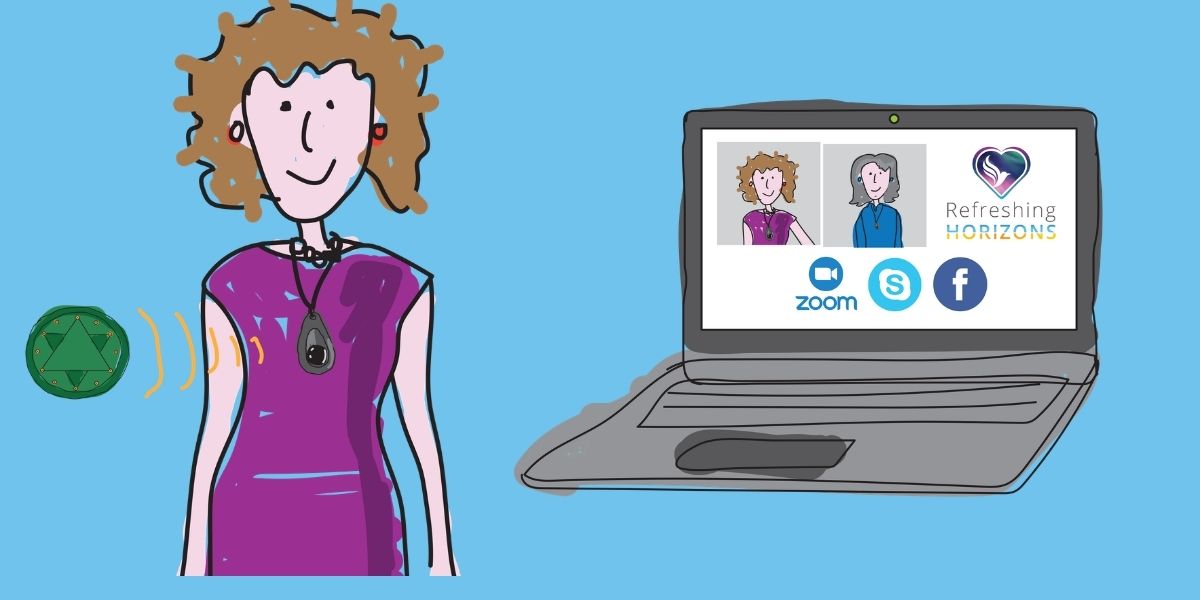

When I tell people that all my sessions are delivered remotely, the response is usually one of two things.
Either: “Oh, that’s convenient.” (They’re thinking Zoom.)
Or a slight pause, followed by: “How does that work, exactly?”
The second response is the more interesting one. And it deserves a proper answer.
What remote bioresonance actually means
When I say remote bioresonance, I don’t mean a video call where you describe your symptoms, and I listen. I mean something quite different.
You don’t need to be present at all. You don’t need to be on a call, or sitting quietly, or doing anything in particular. You can be at your desk, walking the dog, or asleep. Most of my clients don’t know exactly when their session is running — they find out when I tell them it is complete afterwards.
The remote bioresonance session is delivered using the e-Lybra9 bioresonance system, which accesses and rebalances your energy field. Distance makes no practical difference to that process. The system doesn’t need you to be in the room any more than a radio signal needs you to be standing next to the transmitter.
The question people are really asking
When someone asks “how does that work?”, what they’re usually really asking is: “Is this real? Or is it just something you’re telling yourself?”
It’s a fair question. And I think the most honest answer is: I understand the scepticism, because I came from a world that runs on evidence and logic. I spent most of my career in senior IT. Pensions management systems, then Retail and supply chain architecture. The kind of work where if something doesn’t do what it’s supposed to do, you find out very quickly.
I didn’t arrive at energy medicine through wishful thinking. I arrived through results — in my own life, and then in the lives of clients, over twenty years of practice.
The evidence that convinces me
A canine dietitian and behaviourist — professionally sceptical, with every reason to be — booked a remote bioresonance session for her own nervous rescue dog without telling me when. One morning she woke up to a completely different animal. She asked afterwards when the session had run. It had run overnight, the night before everything changed.
Her conclusion: you cannot placebo a dog.
I think about that a lot. The dog had no expectation, no awareness of what was happening, no investment in a particular outcome. It simply responded (or it didn’t). In her case, it did.
This is the kind of evidence that matters to me — not because it’s scientifically controlled, but because it removes the most obvious confounding factor. Belief.
What the e-Lybra9 actually does
The e-Lybra9 is a sophisticated bioresonance system developed by Victor Sims and his team at WDS Global in Worcestershire. It identifies energetic frequencies that are out of balance and introduces corrective frequencies to rebalance them.
During a session, it runs a detailed analysis (physical, emotional, environmental) and then applies balancing programmes relevant to what the system identifies. A typical session from me runs for several hours. The reports I may send afterwards give you a sense of the areas covered, though in my experience the most significant work often happens in the areas that don’t show up in a report at all.
The e-Pendant — taking the work with you
One of the most practical aspects of remote bioresonance is the e-Pendant: a small device I charge with resonances during your session, while those resonances are also sent to your energy field. It then continues listening to your energy field and dispensing required resonances between sessions (worn on a cord or carried in a pocket, working at 7.5cm from the body). The balancing continues for up to two months after a session.
Clients often describe noticing it most on the days they’ve forgotten to wear it. The effect is cumulative rather than dramatic — a gradually shifting baseline rather than a single moment of change.
Flash, my Golden Retriever, wears one on his collar.
Why some practitioners don’t work remotely
Remote delivery isn’t standard across the field. Most practitioners work in person, in clinic, with shorter sessions. This is a simpler model because the client is in the room and can sense the changes. Many do not provide anything to continue the balancing afterwards.
Remote work allows me to run much longer sessions (often six hours or more, compared to a typical one- or two-hour in-person session), work with clients anywhere in the world, and avoid the disruption of travel and scheduling for people who are already busy. The clients who come to me are mostly successful professionals who want support that works in the background of their lives, not another appointment to fit in.
In my experience, the results are at least as strong as in-person work. Often stronger.
A note on expectations
I want to be clear about what this is and what it isn’t.
Bioresonance is a form of complementary and energy medicine. It doesn’t diagnose, treat or claim to cure any medical condition. It works alongside conventional medical care, not instead of it. If you have health concerns, please consult your GP.
What it offers is harder to quantify: a shift in energetic balance that clients often describe as feeling more like themselves, more settled, and better able to access the clarity and energy they know they have.
That’s what twenty years of evidence tells me. And that’s what I offer, from my Cotswold office, to clients I’ve often never met in person.
Distance, as it turns out, is not the point.